
Neuromaps
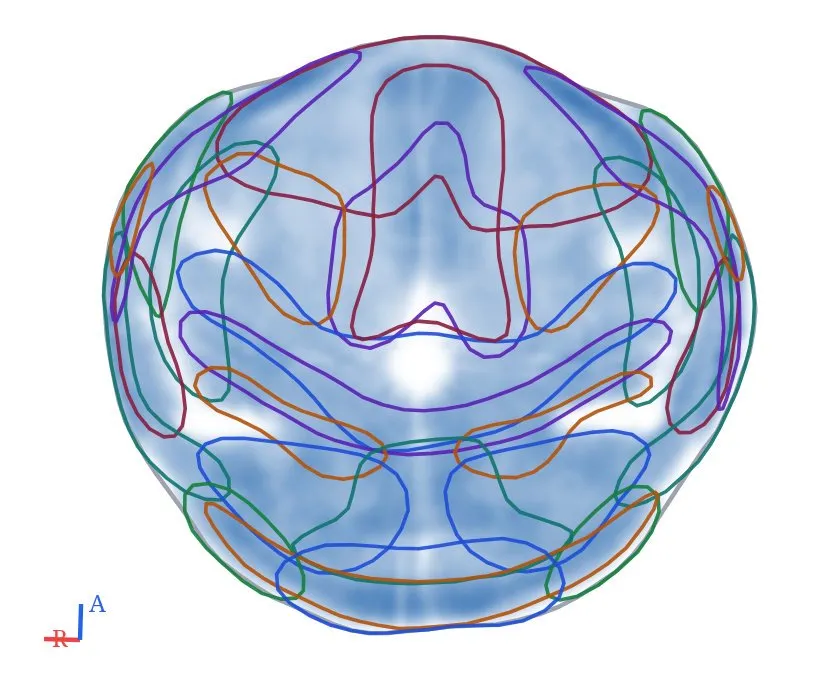
Readings of differences in statistical brain activity obtained from task-based or task-free neuroimaging experiments provide essential insights for a wide range of neuroscientific analyses, including the study of cognitive functions and the comparison of activity patterns across cohorts of individuals. Over the past decades, visualization techniques to show activity within the threedimensional brain volume have been developed. Most approaches have in common that they rely on multiple views to imply spatiality, asking users have to mentally integrate them in order to achieve a coherent holistic understanding. This process is particularly demanding if the results of several experiments are examined in conjunction for comparative analyses. We propose NeuroMaps - a compact fingerprint design which summarizes spatial activity patterns in an intuitive and space-efficient manner. By integrating all relevant information in a single image, NeuroMaps enables neuroscientists and other experts to quickly obtain a coarse overview, rendering it a particularly useful tool for comparing large sets of neuroimaging results.
NeuroMaps




The NeuroMaps design constitues a compact fingerprint for visualizating the brain activity in fMRI images, which was presented at EuroVIS 2026 in Nottingham. This repository contains the core methods and scripts to generate the results images presented within this paper.

Files
- main.py: Example runner that loads nifti activity files and atlas and exports all example visualizations using the
neuromapsmodule. - neuromaps.py: Core library. Public entrypoint
get_neuromap(atlas, loading, shape, ...)computes the saliency map, label contours and projection vectors. This function should also constitute the entry point if the concept is used within another project. - myatlas.nii: Example atlas file used by
main.py. This is a manually simplified version of one of the Harvard-Oxford cortical and subcortical structural atlases, in which smaller areas have been removed/merged.
Usage
After specifying the locations of the input files (loading and atlas) and the output directory of generated files in main.py, the result images can be generated with:
python main.py
Update 2026-07-08
It was discovered that the np.linalg.eig function does not return the eigenvalue/eigenvector pairs in sorted fashion (sorted by the magnitude of the eigenvalues), as expected.
This is relevant, since in cases, where they are not coincidentaly in order the returend projection axes do not correspond to the two most dominant dimensions.
This was fixed but hidden behind a flag (projection_sort_by_eigenvalue in get_neuromap) to ensure backwards compability with the results presented in the paper.
Update 2026-09-16
Another error was fixed in the projection logic by changing the multiplication of within and in-between variances from element-wise Hadamard multiplication to matrix multiplication and transforming the resulting eigenvector matrix.
Additionally a masking was added to the drawing logic in main.py to clip the saliencies to the area within the brain contour.
Update 2026-10-19
A DISCLAIMER, following the regulations of the funding HEREDITARY (grant agreement No 101137074) project, was added.
Contributing
Contributions are welcome!
Feel free to open issues or pull requests at
https://github.com/lenxn/neuromaps.
Acknowledgement
This work is partially supported by the HEREDITARY Project, as part of the European Union’s Horizon Europe research and innovation programme under grant agreement No GA 101137074. We also thank Mattia Veronese from the University of Padova and his group for their insightful discussions and valuable feedback.
When you use the tool for your project, please cite:
- Lengauer, S., Kantz, B., Waldert, P., Tussardi, G., Kohn, N., Schreck, T., "NeuroMaps — A Compact Fingerprint for Analyzing Brain Activity," EuroVis 2026, 2026. doi:10.2312/evs.20261005.
Bibtex:
@inproceedings{10.2312:evs.20261005,
    booktitle = {EuroVis 2026 - Short Papers},
    editor = {Byska, Jan and Ottley, Alvitta and Waldner, Manuela},
    title = {{NeuroMaps - A Compact Fingerprint for Analyzing Brain Activity}},
    author = {Lengauer, Stefan and Kantz, B. and Waldert, P. and Tussardi, G. and Kohn, N. and Schreck, T.},
    year = {2026},
    publisher = {The Eurographics Association},
    ISBN = {978-3-03868-303-2},
    DOI = {10.2312/evs.20261005}
}