
ParamInter
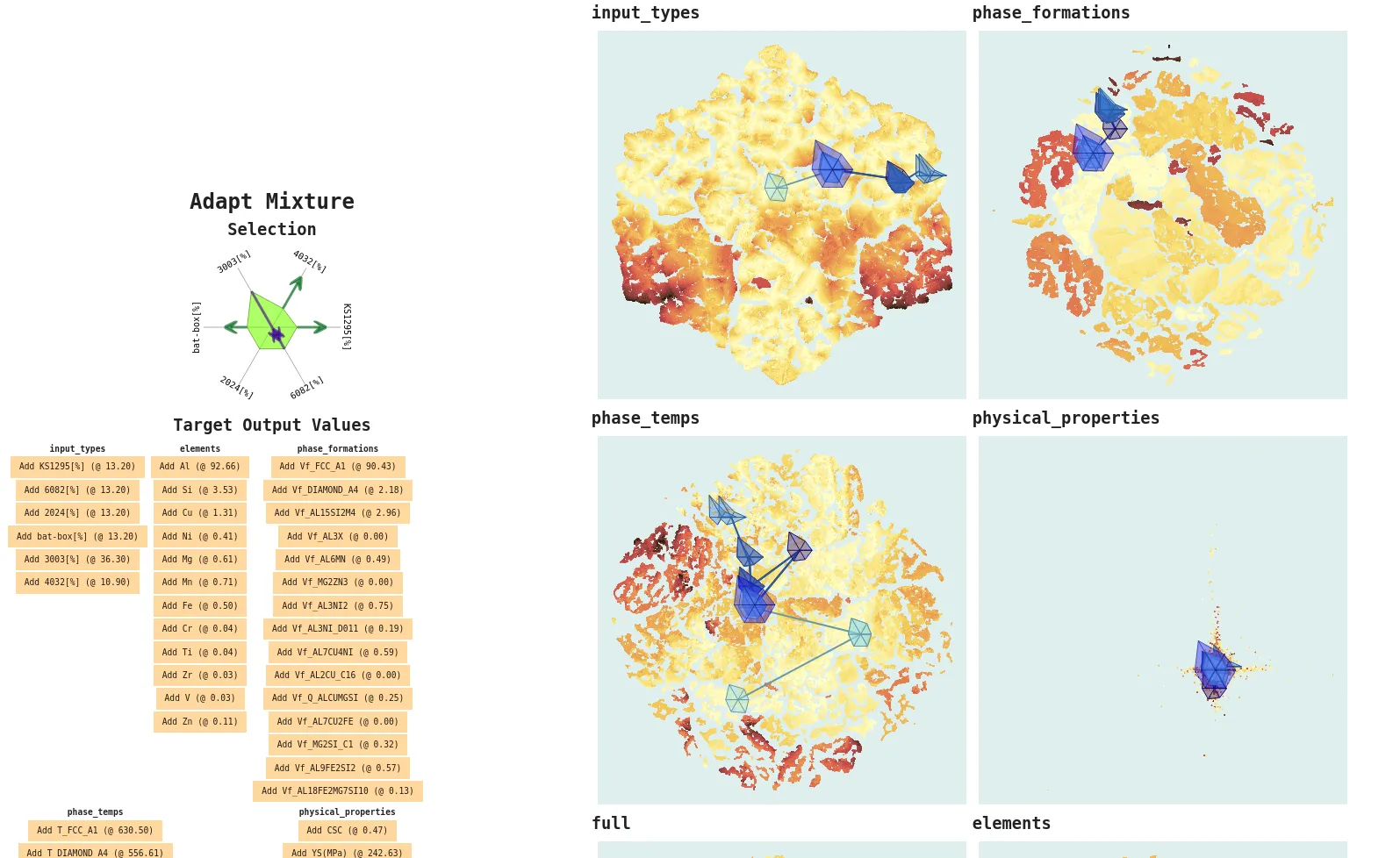
ParamInter is a novel toolset to explore continous input-output parameter sets interactively through guidance by XAI and UCQ. The approach interpolates between selected input samples over an embedded subspace, guiding the user towards required solutions for their target output parameters.
ParamInter



The code behind Parameter Space Analysis through Guided Visual Interpolations, published at EG MLVis 2026.

Research use only. Not a medical device. See DISCLAIMER.md for intended use, data provenance and limitations.
Overview
ParamInter is a tool to explore continuous input-output parameter sets interactively, guided by explainable AI (XAI) and uncertainty quantification (UCQ). Users select a start sample with an editable radar chart, set up a cost function over target output values, and inspect an interpolation from the start towards the lowest-cost sample. The interpolation is shown as small multiples of all inputs and outputs and as a path on t-SNE embeddings of the input, output and combined spaces. LightGBM surrogates, fitted per output column, provide sensitivity hints and SHAP-based effect views; an optional VAE estimates per-column uncertainty.
An earlier version, AlloyInter, was developed for the IEEE SciVis Contest 2025 (arXiv:2509.19202). ParamInter uses no outside service; fonts are served locally.
Data
No data is included in this repository. Datasets are read from $DATA_DIR/datasets/ (default ./data/datasets/), and fitted models are cached under $DATA_DIR/models/.
- Alloy simulation data (IEEE SciVis Contest 2025, CC-BY-4.0): download
Dataset_VisContest_Rapid_Alloy_development_v3.txtfrom Zenodo and save it asdata/datasets/scivis/alloy_data.txt. - Electric arc furnace simulation: generated with
models/eaf/run_simulation.py; the EAF model inmodels/eaf/system_modelis refactored from SayYoungMan/EAF_modelling (MIT). - The MAST, PrivBayes, blast-furnace and Hilti configurations in
backend/datamans/sets.pyrefer to data that is not distributed with this repository.
Datasets are configured as DataConfig entries (backend/datamans/config.py): the first input_cols columns (after an optional leading time column) are inputs, the next output_cols columns are outputs.
Without SETS_CONFIG_JSON, the backend reads every default dataset at startup, so point it to a JSON file that lists only the datasets you have, e.g. data/datasets/config_scivis.json:
{
    "scivis_2025": {
        "data_file": "scivis/alloy_data.txt",
        "data_name": "Alloy Simulation Data (SciVis Contest 2025)",
        "short_data_name": "scivis",
        "input_cols": 6,
        "output_cols": 64,
        "modes": ["tsne"],
        "is_config": true
    }
}
Running locally
Docker
The backend and the frontend are built as two images (as in .gitlab-ci.yml):
docker build -t paraminter-backend .
docker run -p 8000:8000 -v "$PWD/data:/app/data" \
    -e SETS_CONFIG_JSON=/app/data/datasets/config_scivis.json paraminter-backend

docker build -t paraminter-frontend ./frontend
docker run -p 8080:80 -e PARAM_INTER_API_BASE_URL=http://localhost:8000 \
    -e PARAM_INTER_SITE_BASE_URL= paraminter-frontend
Then open http://localhost:8080/.
Development setup
Backend (Python 3.13, uv); the index strategy is needed because of the NVIDIA package index:
uv sync --index-strategy unsafe-best-match
SETS_CONFIG_JSON=data/datasets/config_scivis.json uv run python -m uvicorn backend:app --reload --port 8091
Frontend (expects the API on port 8091, see frontend/.env.development):
cd frontend
npm i -D
npm run dev
Then open http://localhost:3000/param-inter/.
Environment variables: DATA_DIR (data directory), SETS_CONFIG_JSON (dataset configuration), EMBEDDING (tsne, umap or pca, used for the default configurations).
Citation
@inproceedings{2026-paraminter,
	booktitle = {Machine Learning Methods in Visualisation for Big Data},
	editor    = {Archambault, Daniel and Nabney, Ian and Peltonen, Jaakko},
	title     = {{Parameter Space Analysis through Guided Visual Interpolations}},
	author    = {Kantz, Benedikt and Waldert, Peter and Lengauer, Stefan and Staudinger, Clemens and Schuster, Stefan and Schreck, Tobias},
	year      = {2026},
	publisher = {The Eurographics Association},
	isbn      = {978-3-03868-310-0},
	doi       = {10.2312/mlvis.20261001}
}
Acknowledgement

Funded by the European Union under grant agreement No 101137074 (HEREDITARY). Views and opinions expressed are however those of the author(s) only and do not necessarily reflect those of the European Union or the European Health and Digital Executive Agency (HaDEA). Neither the European Union nor the granting authority can be held responsible for them.
License
MIT, see LICENSE. The bundled Roboto and Roboto Mono fonts are under the SIL Open Font License 1.1, see frontend/public/fonts/.