
Neuronal Lens
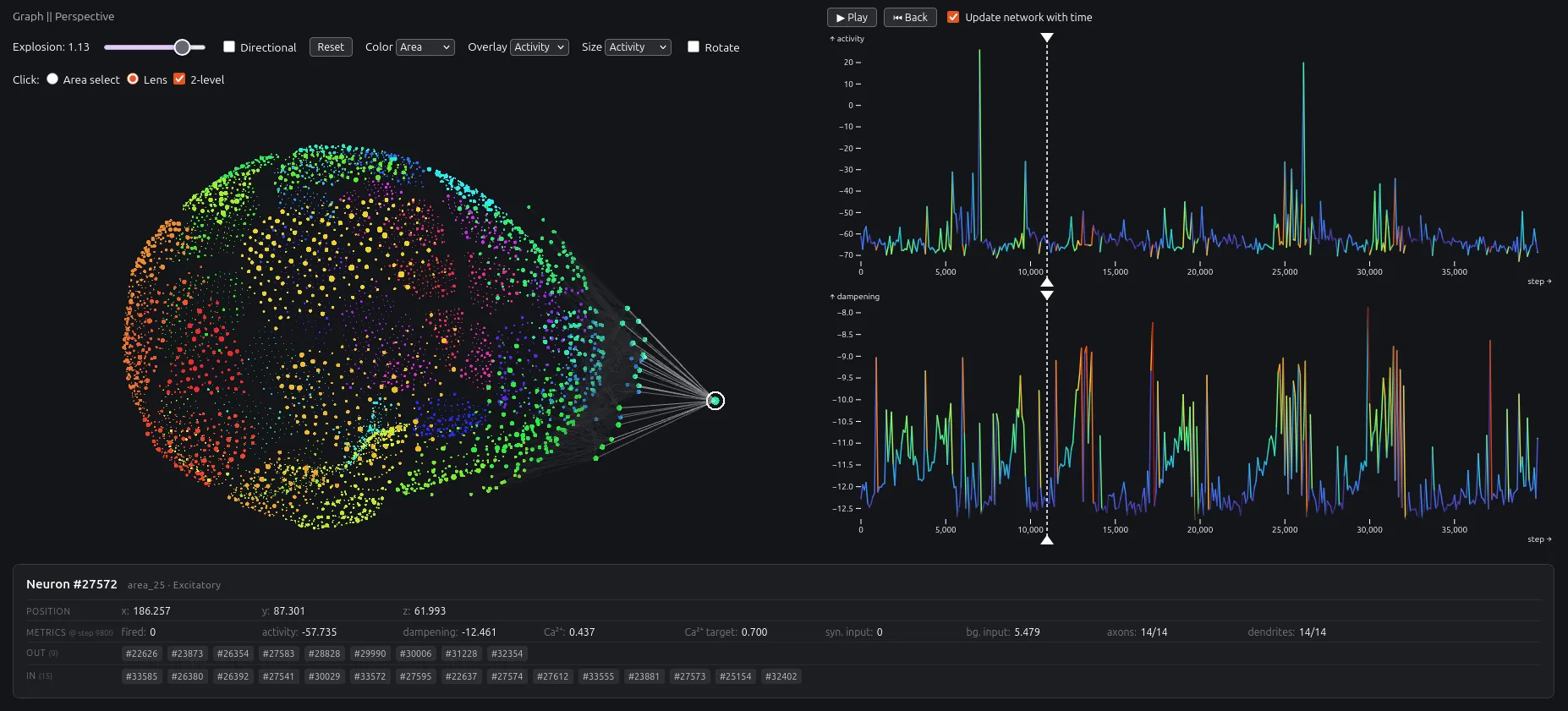
The Neuronal Lens tool visualises a simulation of the brain, focussing on the brain connectome and activity data. On the left, we have a shared view between the neuron graph and a perspective view, with an integrated lens. On the right, the varying quantities described above are displayed, for one selected neuron, as a coloured line chart. The colour intensity is used to indicate areas of high activity, although that can be adjusted.
Neuronal Lens


Code behind Interactive 3D Exploration of Large-Scale Neuronal Network Simulations with a Graph Lens, presented at EG VCBM 2026.

Research use only. Not a medical device. See DISCLAIMER.md for intended use, data provenance and limitations.
Overview
Neuronal Lens is a web visualisation for exploring large-scale simulations of neuronal networks. It links three views of the same simulated brain: a 2D graph view of the connectome, projected from the neurons' 3D positions; a navigable 3D perspective view; and a per-neuron timeseries chart. A graph lens provides focus and context in the dense spatial graph.
Data
Neuronal Lens visualises the viz-stimulus scenario of the IEEE SciVis Contest 2023 dataset (Dataset of Neuronal Network Simulations of the Human Brain, CC BY 4.0): 50,000 simulated neurons with positions, changing connectivity and per-neuron monitor timeseries.
The data is computer-generated simulation output, not measurements of people.
It is not part of this repository; preprocess.py reduces it to compact .npy arrays that the frontend loads from public/stimulus/.
Running locally
Download the dataset (viz-stimulus.zip, about 9.8 GB) and preprocess it into public/stimulus/:
mkdir -p public/stimulus && cd public/stimulus
curl -fL "https://zenodo.org/records/10519411/files/viz-stimulus.zip?download=1" -o viz-stimulus.zip
unzip viz-stimulus.zip -d viz-stimulus
unzip viz-stimulus/viz-stimulus/monitors.zip -d monitors
cp viz-stimulus/viz-stimulus/network/* viz-stimulus/viz-stimulus/positions/* .
rm -rf viz-stimulus viz-stimulus.zip
cd ../..
uv run --group preprocess python preprocess.py --monitors-dir public/stimulus/monitors --output-dir public/stimulus
By default only the first 400 simulation steps are extracted; see python preprocess.py --help for more steps and metrics.
Then start the development server:
bun install
bun dev
The docker-compose.yml runs the same download and preprocessing in a downloader container and serves the built frontend with nginx.
It is set up for the demo server (an external web network behind Traefik) and publishes no port by itself.
Citation
If you find Neuronal Lens useful or relevant to your work, please feel free to cite it as follows:
@inproceedings{2026-neuronal-lens,
	booktitle = {VCBM 2026 - Eurographics Symposium on Visual Computing for Biology and Medicine},
	editor    = {Krueger, Robert and Mörth, Eric and Furmanová, Katarina},
	title     = {{Interactive 3D Exploration of Large-Scale Neuronal Network Simulations with a Graph Lens}},
	author    = {Waldert, Peter and Kantz, Benedikt and Tussardi, Gaia and Lengauer, Stefan and Schreck, Tobias},
	year      = {2026},
	publisher = {The Eurographics Association},
	issn      = {2070-5786},
	isbn      = {978-3-03868-324-7},
	doi       = {10.2312/vcbm.20261012}
}
Acknowledgement

Funded by the European Union under grant agreement No 101137074 (HEREDITARY). Views and opinions expressed are however those of the author(s) only and do not necessarily reflect those of the European Union or the European Health and Digital Executive Agency (HaDEA). Neither the European Union nor the granting authority can be held responsible for them.
License
MIT, see LICENSE.